Composio alternatives for AI agents, compared by job
Pipedream, Arcade, Nango, Zapier MCP and looot as Composio alternatives, compared by sign-in model, billing and the limit to know before you switch.
The looot team · · 11 min read
On this page
The right Composio alternative depends on the job. Pipedream, Arcade, Nango and Zapier MCP also give an agent managed sign-in to a user's own apps. looot is different, a catalog of data and scraping operations billed per call. Pick an actions layer when the agent acts inside accounts, and a data catalog when it looks things up.
Composio's homepage describes giving an AI secure access to a large set of apps, with managed sign-in, an SDK and MCP. People look for an alternative for different reasons. Some want an open-source option, some want per-user permissions that follow their identity provider, some already pay for a tool that has an MCP server, and some find that their agent needs data, not account actions. This post sorts five options by that last question and states the limit of each.
Composio alternatives: the short answer
Each bullet names one need.
- looot, best for an agent that looks up data and scrapes the web, billed per call from one balance.
- Pipedream, best for managed auth plus a proxy to call any endpoint with a user's credentials.
- Arcade, best for enterprise control, with permissions that follow your identity provider and an audit record per action.
- Nango, best for an open-source, self-hostable layer for sign-in, syncs and webhooks.
- Zapier MCP, best for teams that already run on Zapier and want agents to reuse its connections.
| Alternative | Sign-in model on its page | Billing as the page states it | Named limit |
|---|---|---|---|
| looot | One token for the catalog, browser sign-in over MCP | Per call from a prepaid balance, quoted first | Not built for acting inside a user's own accounts |
| Pipedream | Managed auth with hosted OAuth clients | No paid plan until you move to production | Production billing is on a separate pricing page |
| Arcade | Authentication runs against your identity provider | Free to start, priced by usage | Aimed at enterprise volume, no amounts on the page |
| Nango | OAuth, API keys and token refresh handled for you | Not stated on the homepage | You build integrations as code |
| Zapier MCP | Credentials stay in Zapier's managed connection layer | Two tasks from your quota per tool call | Draws on a plan quota, not a wallet |
Prices change, so this post types none. The live table reads the looot catalog when the page loads, to show the kind of job looot covers.
How we compared these alternatives
We opened each vendor's public page on 2026-10-12 and wrote down how it describes sign-in, what an agent can call and how it bills. Where a page gives no billing, the table says so. We did not sign up for any of them, run a tool call or compare speed, so we make no claim about reliability or price. Composio is the reference point, and its own page is read the same way.
looot is listed first and looot publishes this post, so discount that placement. It is also the one entry that does a different job. Entries 2 to 5 run from the closest match to Composio's account-actions model to the furthest, which is our reading of the pages and not a measurement. We left out options we could not read on a public page.
What Composio does, so you can compare
Per its homepage, Composio sits between an AI assistant and apps, finds the right action across its catalog and runs it. It supports any MCP client, and what an MCP server is explains the term. It also offers an SDK. Managed Auth covers OAuth, API keys and token refresh. The page lists a free Hobby plan with a tool-call allowance each month. Custom MCP servers can be added for free, but only for apps that already have one. Everything below is measured against that.
1. looot, best for data lookups and scraping rather than account actions
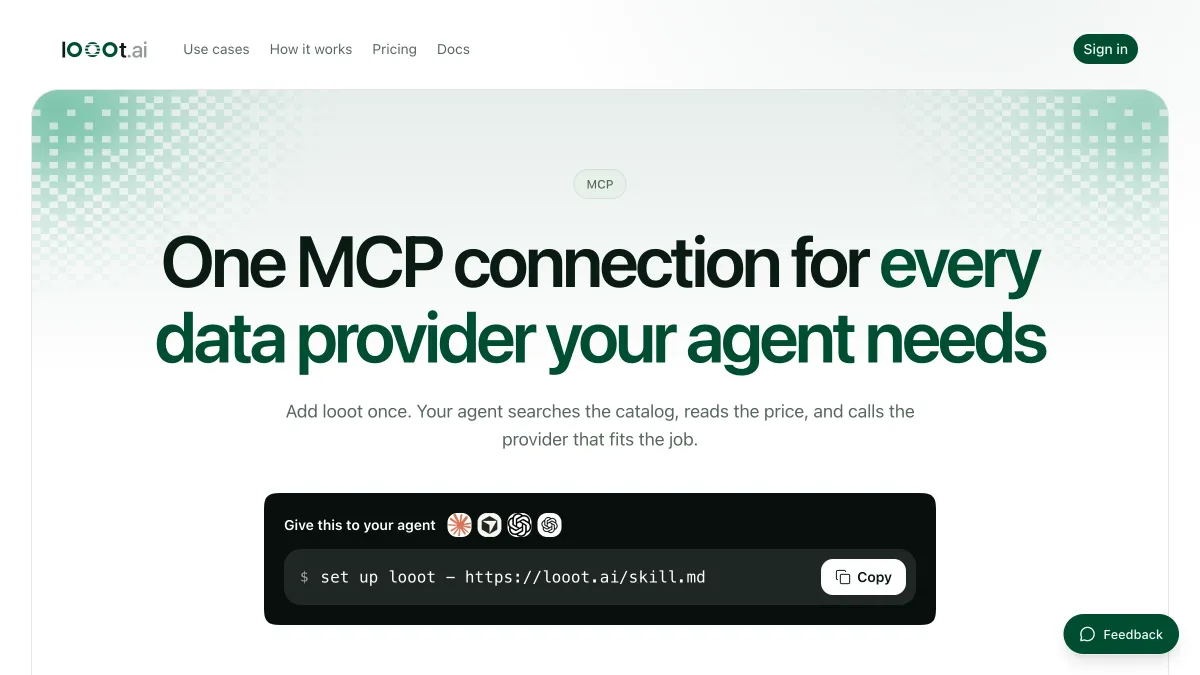
looot is a catalog of paid data and scraping operations behind one token and one prepaid balance. The agent searches by job, reads the inputs and the quoted price and runs the operation. Its pricing page says there is no subscription and that on looot's own key a fee is disclosed before the run. If the work is finding emails, enriching companies, searching the web or scraping pages, this is the shape that fits.
Best for
- An agent that does lookups and scraping and should see one bill.
- Comparing the price of the same job across providers.
Strengths
- No per-user sign-in step for the data operations.
- The price is quoted before each call.
Limits
- It is not built around acting inside a user's own accounts, such as sending from their mailbox. Use an actions layer for that.
- No free trial credit. You top up before the first run.
- Scheduled runs are not available yet.
Does not fit an agent whose job is to post, send or update in each user's own apps.
2. Pipedream, best for managed auth plus a proxy
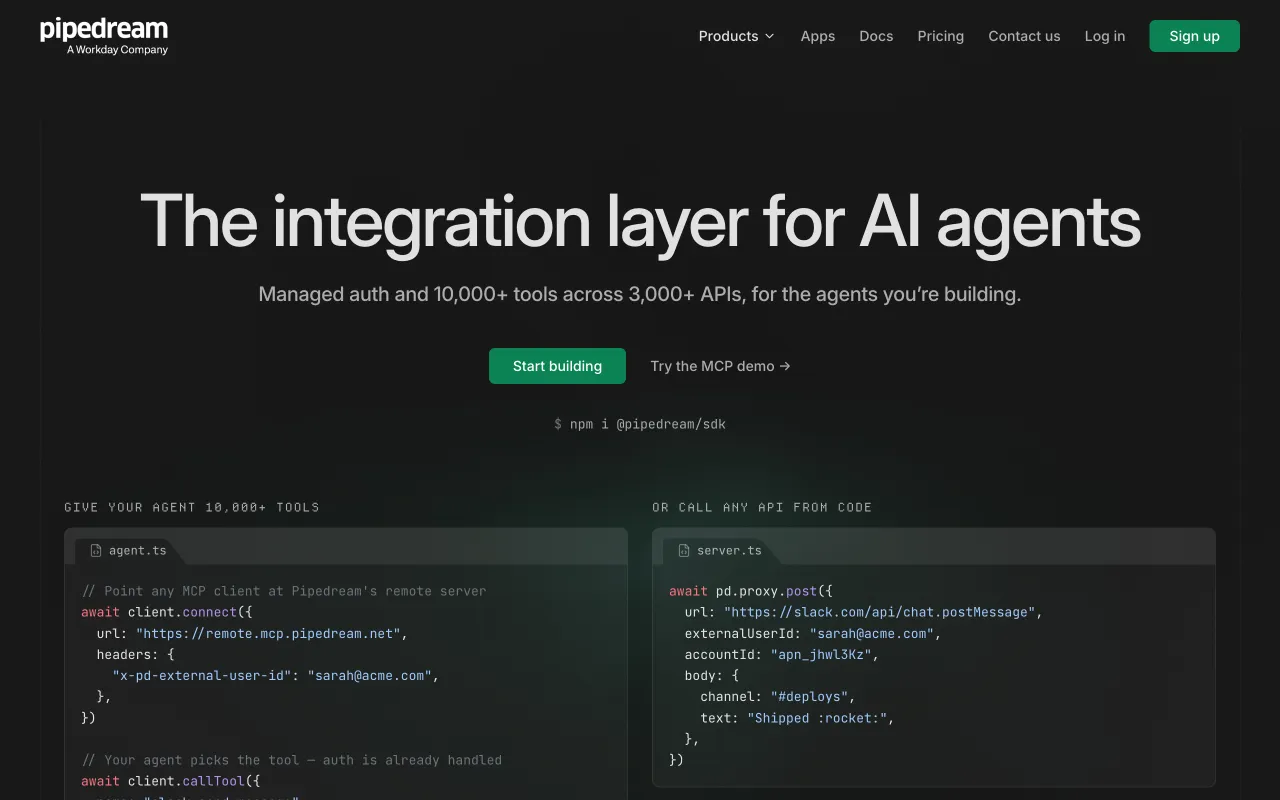
Pipedream calls itself the integration layer for AI agents, with managed auth and a large set of tools and APIs. Its page offers one MCP endpoint that runs tools with each user's connected accounts. Users authorize apps through a hosted Connect Link or an embedded flow, and Pipedream stores and refreshes the credentials. A proxy lets you call any endpoint on the supported APIs with the user's credentials attached, and prebuilt triggers send app events to your endpoint.
Best for
- A product where each user connects their own accounts.
- Calling an API that has no prebuilt tool, through the proxy.
Strengths
- You never touch a credential, per its page.
- Full access in development with no credit card.
Limits
- The page says no paid plan until you move to production and gives no production billing, so read its pricing page.
- No rate limits or quotas are stated on the homepage.
Does not fit a team that wants a per-call price for data lookups.
3. Arcade, best for enterprise control

Arcade describes itself as the actions runtime between your agents and every system they reach. Authentication runs against your identity provider and authorization is delegated, so the agent acts as its user. Per its FAQ, every action runs at the intersection of what the user can do and what the agent is scoped to do, and crossing either line stops the action. Each action produces one audit record, and pre- and post-tool-call hooks add custom policies. It deploys in the cloud, on premises, air-gapped or hybrid.
Best for
- A company with an identity provider and a security review to pass.
- Tools that must run with the user's own permissions.
Strengths
- Policy hooks run before and after each call.
- You choose where it runs.
Limits
- The page says free to start and priced by usage, designed for enterprise volume, and gives no amounts.
- Its sign-in model assumes you have an identity provider to connect.
Does not fit a solo developer who wants a flat per-call price for lookups.
4. Nango, best for an open-source integration layer
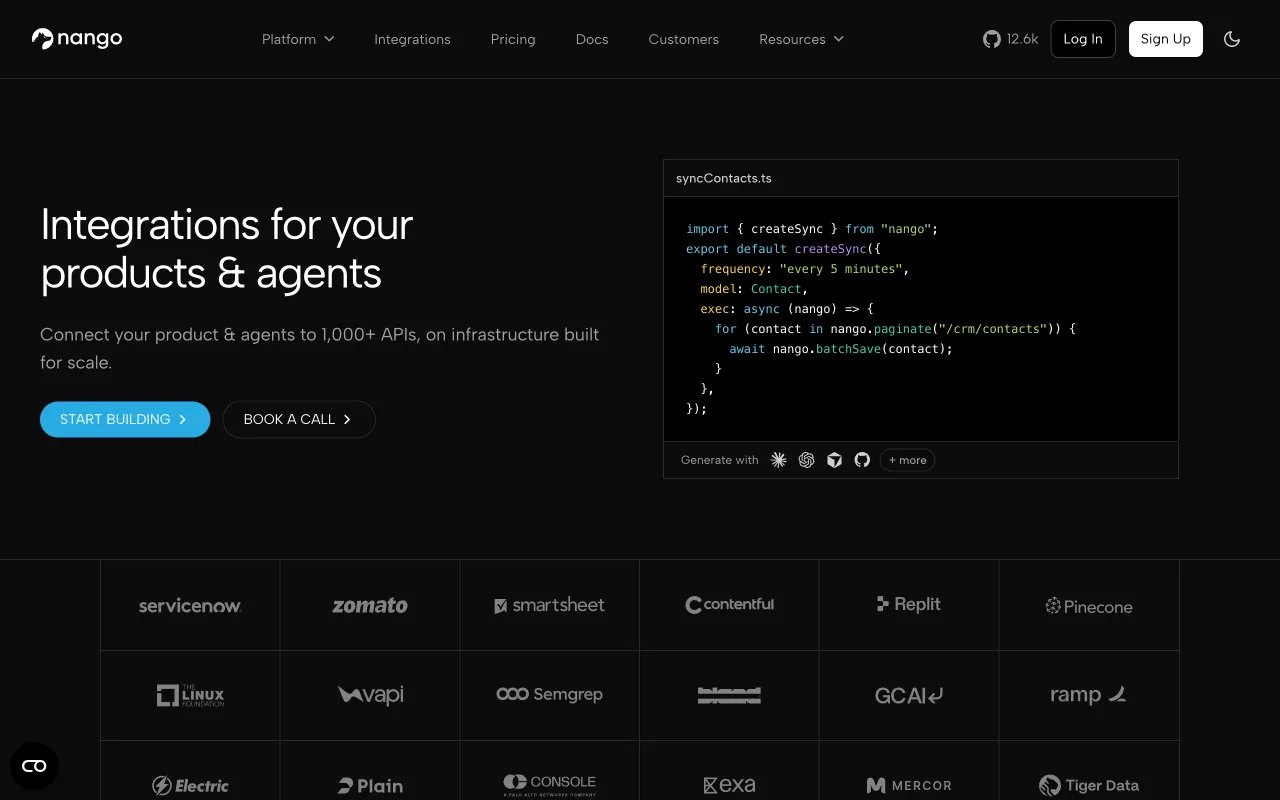
Nango describes itself as integrations for your products and agents. It handles OAuth, API keys and token refresh for each API, and it can expose an integration as a tool an agent calls. Beyond sign-in it offers managed syncs, webhooks, a request proxy and a unified API. Its homepage states it is fully open source and can be self-hosted.
Best for
- A team that wants to read the code and run it on its own infrastructure.
- Syncing data from an app with sync code that you own.
Strengths
- Open source and self-hostable, per its page.
- Sign-in, syncs and webhooks come from one layer.
Limits
- The homepage does not say how Nango is billed, so read its pricing page.
- Integrations are written as code, so expect engineering time, which the page says you can speed up with generated code.
Does not fit a team that wants a prebuilt tool list with no code.
5. Zapier MCP, best for teams that already run on Zapier
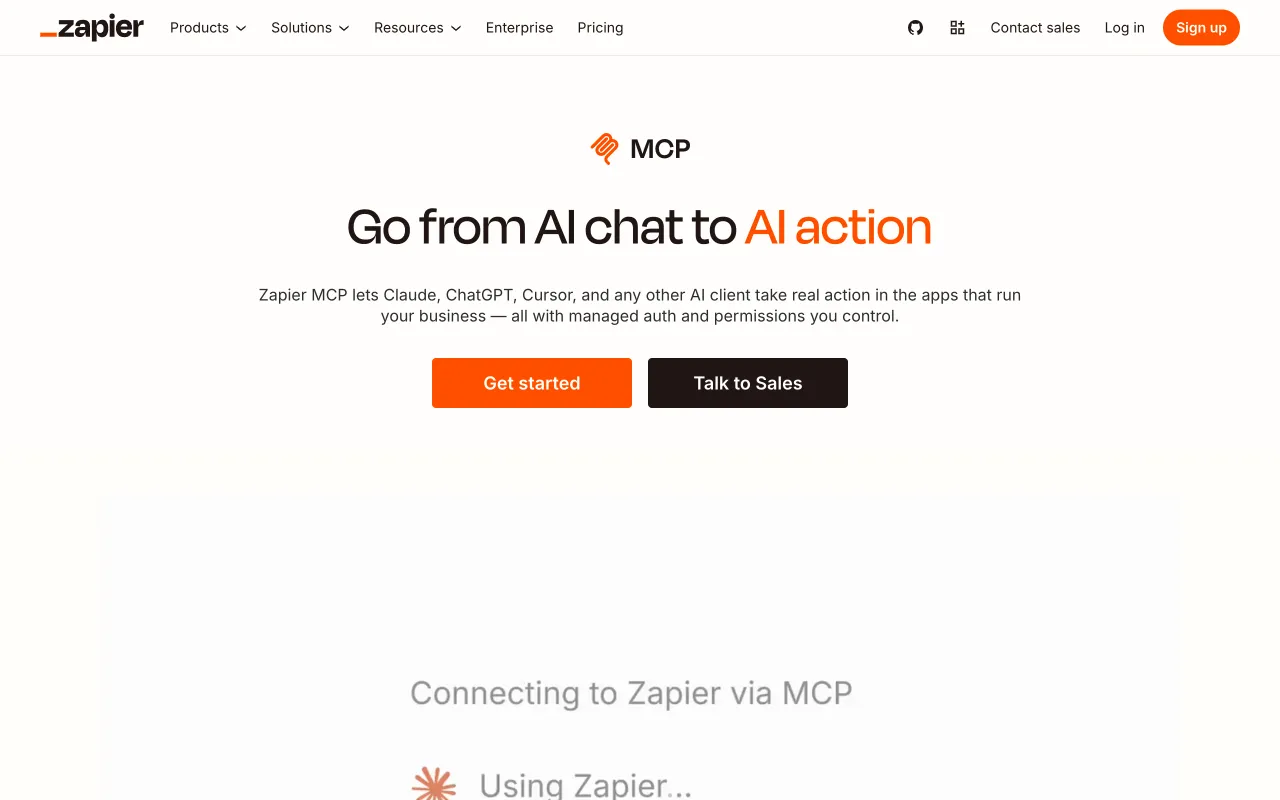
Zapier describes Zapier MCP as a secure way to connect AI clients such as Claude, ChatGPT and Cursor to the apps you use through Zapier. The agent searches Zapier's catalog of apps, triggers and actions and runs the one that fits. Credentials stay in Zapier's managed connection layer. Its FAQ says MCP is included in every Zapier plan and each tool call uses two tasks from the same quota that Zaps use.
Best for
- Teams that already pay for Zapier and have connections set up.
- Reusing a saved workflow as a skill.
Strengths
- No new vendor if Zapier is already in use.
- Credentials stay out of the model.
Limits
- Each tool call uses two tasks from your plan quota, so heavy use eats the quota that your Zaps need.
- Building and deploying Next Gen Zaps from an AI client is in early access.
Does not fit an agent that makes a large number of small lookups.
How to choose
Does the agent act inside accounts or look things up?
For actions inside a user's own accounts, choose among Pipedream, Arcade, Nango and Zapier MCP. For lookups and scraping, choose looot. Many teams use both. The MCP gateway post explains where each sits.
Do you need open source or enterprise control?
Open source and self-hosting point to Nango. An identity provider and policy hooks point to Arcade. A shared task quota points to Zapier MCP.
How do you want to pay?
Each vendor's pricing page names its billing unit, and the units differ, a task, a call or a credit. What 1,000 lookups cost shows the arithmetic for per-call billing.
| Your need | Pick | Why |
|---|---|---|
| Data lookups and scraping per call | looot | One balance, price quoted first |
| Users connect their own apps, with a proxy | Pipedream | Managed auth and a request proxy |
| Permissions that follow your identity provider | Arcade | Delegated authorization and audit records |
| Open source, self-hosted | Nango | Open source layer |
| Already on Zapier | Zapier MCP | Reuses your connections and quota |
How to run this with an agent
- Connect your agent to looot once with the setup line in the prompt below.
- List the two or three jobs the agent must do, and mark each as a lookup or an action in a user's account.
- Give the lookups to looot and ask the agent to list the operations and prices before running.
- Keep the account actions in the tool you picked above.
- Run one lookup end to end before you add more.
Prompt for your agent
Split lookups from account actions
What this post does not cover
It compares five options by what their public pages say. It does not measure tool quality, count integrations or test a sign-in flow, and it leaves out tools we could not read on a public page. A recurring job needs scheduled runs, which looot does not offer yet, so run it by hand.
Last checked 2026-10-12 against each vendor's public page and the public looot catalog at https://api.looot.ai/v1/public-catalog. Author: the looot team.
Questions
Keep reading
MCP gateway: what it does and when an agent needs one
An MCP gateway puts many tools behind one connection, one login and one bill. How it works, when you need one, and what looot's gateway does.
The looot team · · 7 min read
MCP vs API for agents: when each one fits
MCP and a plain API both let an agent reach outside data. What the agent handles in each, when to pick which, and a prompt to test both on your job.
Walid Boulanouar · · 5 min read
What 1,000 lookups cost: reading the looot catalog
How to work out the cost of 1,000 lookups from the live looot catalog, and why the cheapest provider is chosen per call instead of once per project.
Luisa · · 4 min read
Try it with the agent you already use
Start your workspace, top up, and paste one prompt into your agent.