Best API marketplaces for AI agents and RapidAPI options
Five places an AI agent can find and call third-party APIs, from RapidAPI, now Nokia API Hub, to Apify and a pay-per-call catalog, with the limit of each.
The looot team · · 11 min read
On this page
An API marketplace is a place to find third-party APIs and call them under one account. For AI agents the useful choices are RapidAPI, which now calls itself Nokia API Hub, the Apify Store, Bright Data's dataset marketplace, the mcp.so directory and looot's pay-per-call catalog. They differ in who lists, how you pay and whether an agent can use them.
A developer who needs a third-party API usually browses a catalog, picks one and subscribes. An agent has different needs. It has to find an API from a task description, read the inputs, call it and pay without a person clicking through a checkout. This post compares five places by those needs, using only what each one's own public page says, and ends with a plain way to choose.
API marketplaces for agents: the short answer
Each bullet names one need.
- looot, best for an agent that wants one token and one prepaid balance across many data providers.
- Nokia API Hub, formerly RapidAPI, best for publishing or consuming APIs through a catalog built for developers.
- Apify Store, best for ready-made web data Actors that an agent can discover and run.
- Bright Data, best for buying datasets and scraper endpoints from one large web data vendor.
- mcp.so, best for finding MCP servers that other people have built.
| Place | What you find | Who lists it | Billing as the page states it | Named limit |
|---|---|---|---|---|
| looot | Data and scraping operations from many providers | looot adds providers to its catalog | Per call from a prepaid balance, quoted first | Young catalog, no free trial credit |
| Nokia API Hub | APIs from many publishers | Publishers list their own APIs | Not stated on the homepage | Homepage does not mention agents or MCP |
| Apify Store | Actors, serverless web programs | Mostly independent creators | Plan fee plus pay-as-you-go usage | Each Actor sets its own price and input |
| Bright Data | Datasets, scraper APIs, proxies | One vendor | Not described on the homepage | One vendor's catalog, not many |
| mcp.so | A directory of MCP servers | The community, by submission | The page does not say | A directory, so you still hold each key |
Prices change and the billing units differ, so this post types none. The live tables below read the looot catalog when the page loads.
How we compared these marketplaces
We opened each place's own public page on 2026-10-12 and recorded what it says about what is listed, who lists it, how it bills and whether it mentions agents or MCP. Where a page is silent, the table says so. We did not sign in to any of them, run a call, or test a listing, so we make no claim about quality, uptime, speed or price.
The order starts with the places an agent can use with the fewest manual steps, judged from the pages. looot is listed first and looot publishes this post, so discount that placement. We left out marketplaces for end-user apps and no-code templates, because an agent calls an API and does not install an app. We also left out cloud provider marketplaces, whose billing we did not read.
1. looot, best for one balance across many data providers
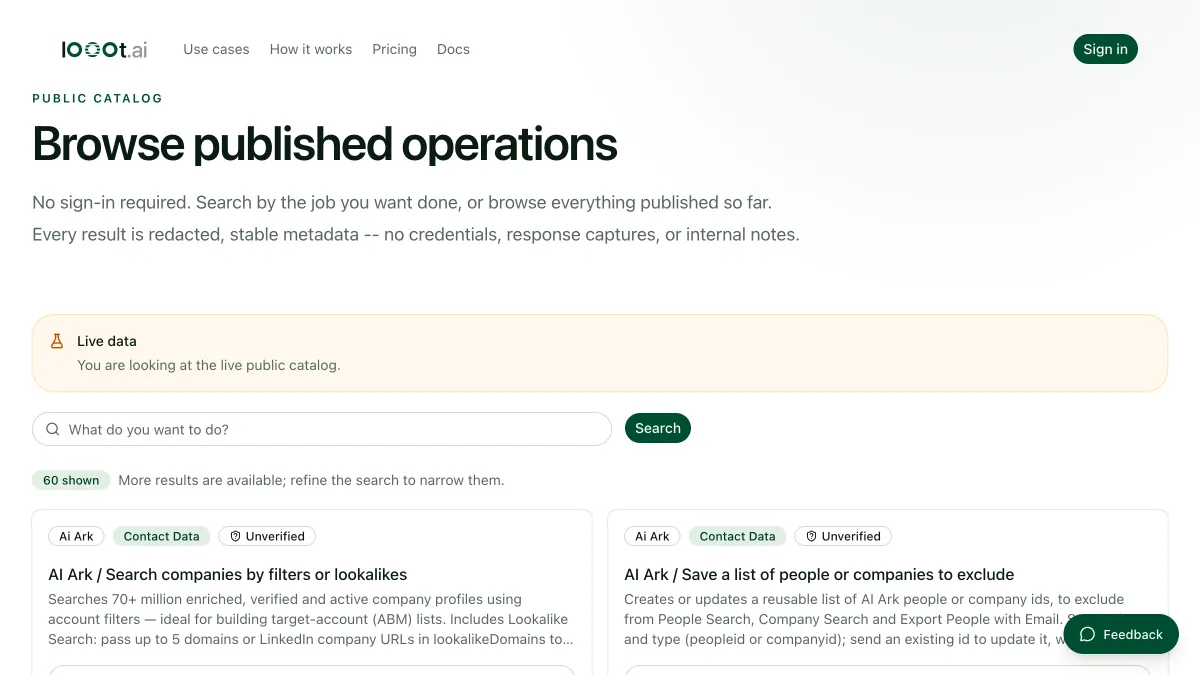
looot is a catalog of paid data and scraping operations. Its public catalog page says you can browse published operations without signing in, and that each result is redacted metadata with no credentials. An agent connects once, searches the catalog by job, reads the inputs and the quoted price, and runs the operation. Billing is per call from one prepaid balance.
Best for
- An agent that needs search, scraping, enrichment and social data and should see one bill.
- Comparing the price of the same job across providers before running it.
Strengths
- No sign-in is needed to read the catalog, so an agent can plan before an account exists.
- The price is quoted before the call, and a failed call is not charged, per looot's own pages.
Limits
- The catalog is young next to the older marketplaces, so a niche API may not be in it yet.
- There is no free trial credit. You top up before the first run.
- Scheduled runs are not available yet, so a recurring job runs by hand.
Does not fit someone who wants to publish their own API and collect revenue from it.
2. Nokia API Hub, formerly RapidAPI, best for a developer-built catalog
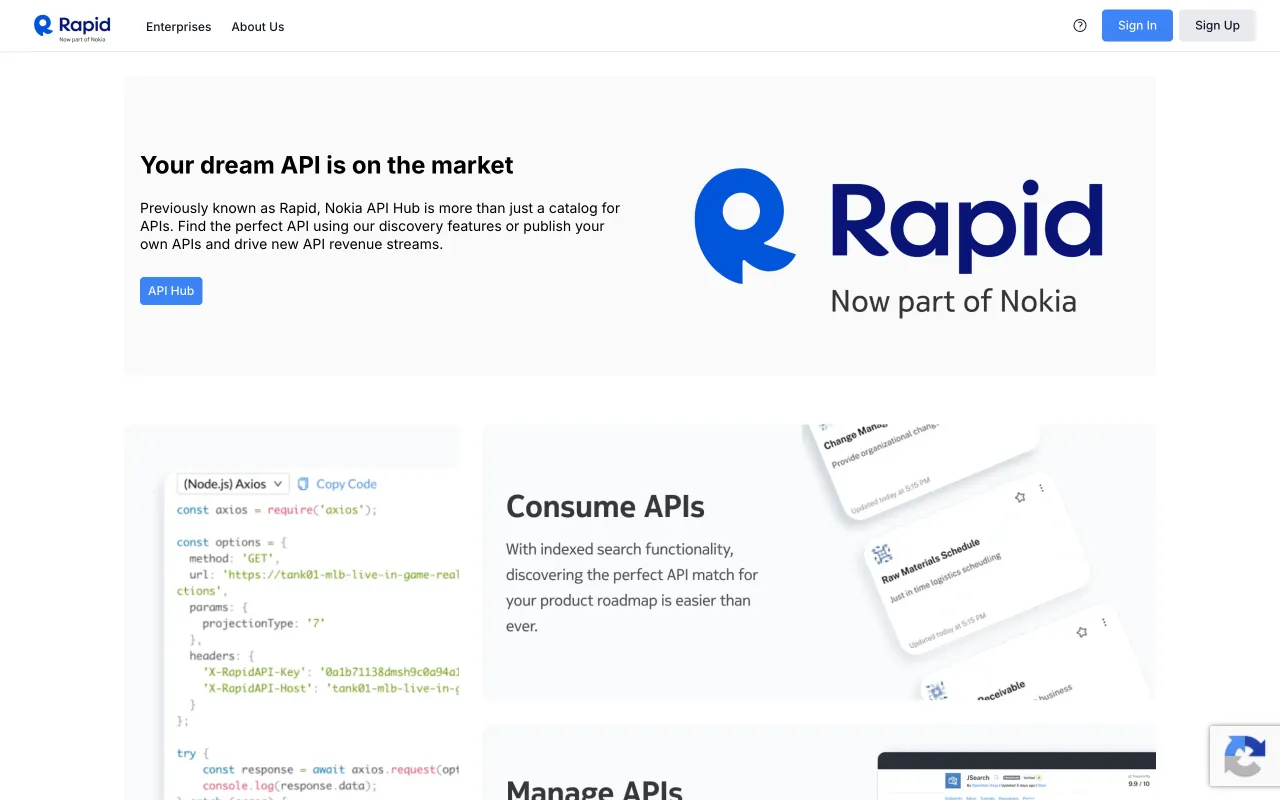
The rapidapi.com homepage now reads "Previously known as Rapid, Nokia API Hub is more than just a catalog for APIs." It says you can find an API using its discovery features or publish your own and drive new API revenue streams. The footer lists a Public Hub and an Enterprise Hub, with sections on consuming, building and testing APIs. The code sample on the page sends the request with an X-RapidAPI-Key header.
Best for
- A developer who wants to browse many publishers' APIs and subscribe to the ones they need.
- A team that wants to publish its own API into a catalog.
Strengths
- It is built around both sides, the people who publish APIs and the people who consume them.
- Discovery is by search, so you can find an API by what it does.
Limits
- The homepage text does not mention AI agents or MCP, so an agent needs a person to set up the account and subscriptions.
- The homepage does not say how calls are billed. Read the plan on each API's own page.
Does not fit an agent that has to find, pay for and call an API on its own.
3. Apify Store, best for ready-made web data Actors
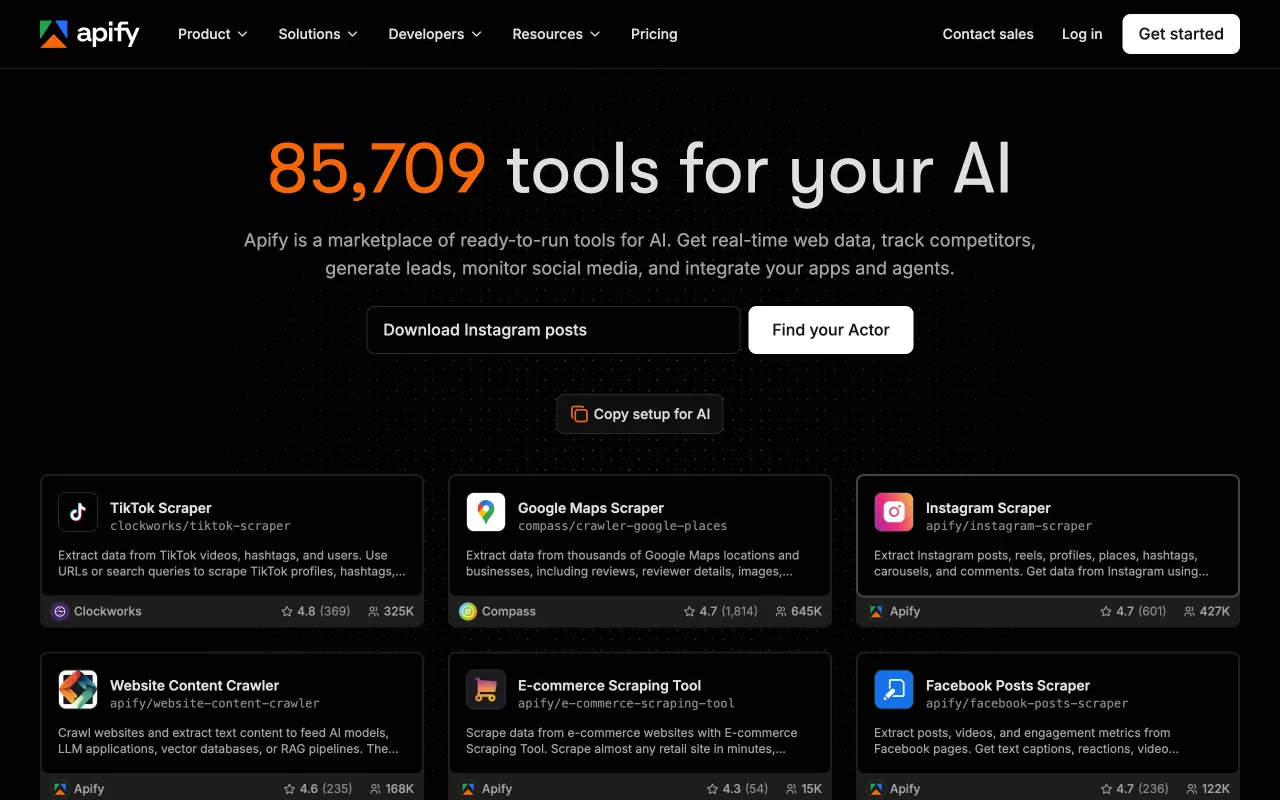
Apify calls itself a marketplace of ready-to-run tools for AI that automate work on the web. An Actor is a serverless program that takes JSON input, runs on Apify's infrastructure and returns structured output. Most are built, priced and maintained by independent creators. Apify runs a hosted MCP server, and per its docs an agent can search Actors, read an Actor's inputs and pricing, run it and fetch the output.
Best for
- Getting data from a site that already has a maintained Actor.
- An agent that should discover a tool by describing the job.
Strengths
- An agent can read an Actor's pricing before it runs, per the MCP docs.
- Account creation is free and needs no credit card, per its homepage.
Limits
- Quality and price depend on each creator, so two Actors for one job can differ.
- Running an Actor through MCP waits up to 45 seconds and returns a run status. The output is a second call.
Does not fit a job that needs one fixed input shape across vendors.
4. Bright Data, best for datasets and scraper endpoints from one vendor
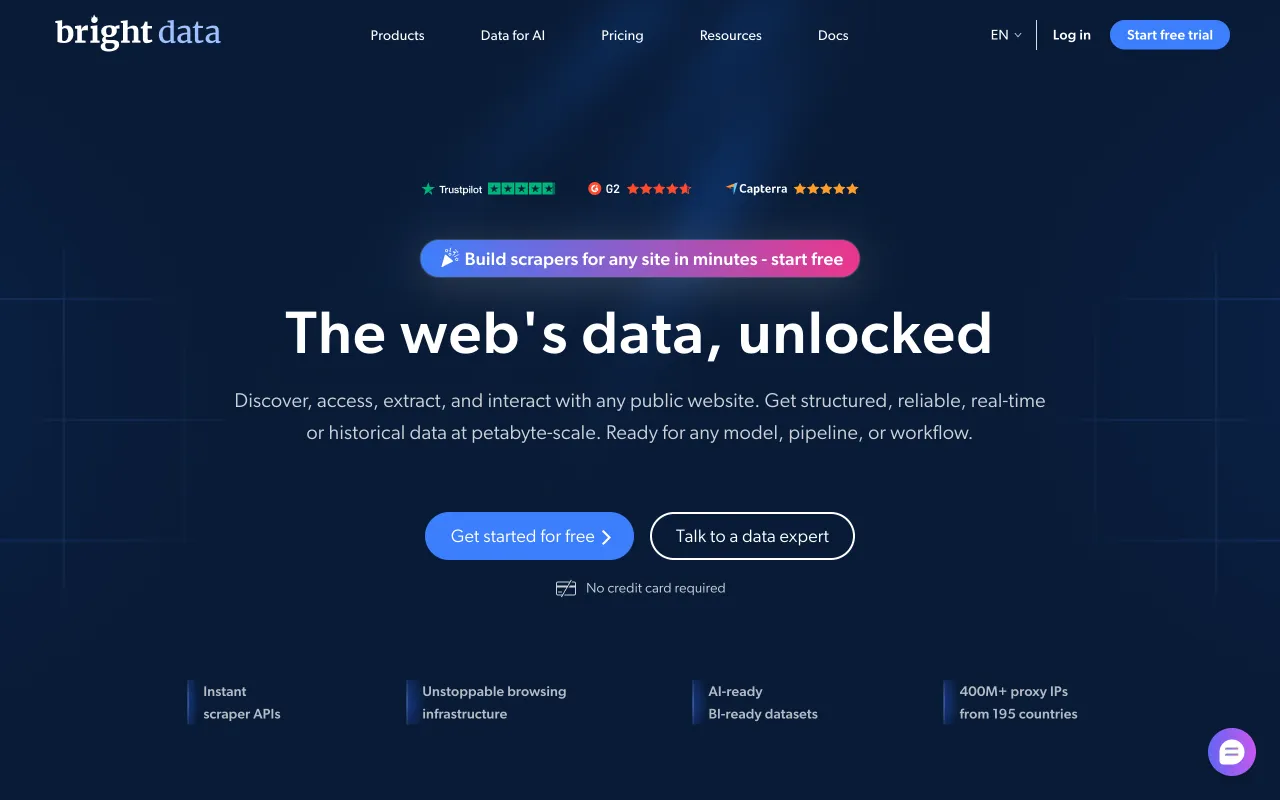
Bright Data describes itself as web data infrastructure for humans and AI agents. Its platform list includes a Dataset Marketplace of datasets from popular domains, Scraper APIs with pre-built or custom-made scraping endpoints, and a set of web access APIs. It also publishes an MIT-licensed MCP server on GitHub for web search, page scraping and browser automation.
Best for
- Buying a dataset of a popular domain instead of scraping it yourself.
- Pre-built scraper endpoints for large platforms.
Strengths
- A free start with no credit card, per the homepage.
- One vendor covers datasets, scrapers and access APIs.
Limits
- It is one company's catalog. It is not a marketplace of many publishers.
- The homepage does not describe how it bills, so read its pricing before you plan volume.
Does not fit a team that wants many different vendors under one balance.
5. mcp.so, best for finding MCP servers
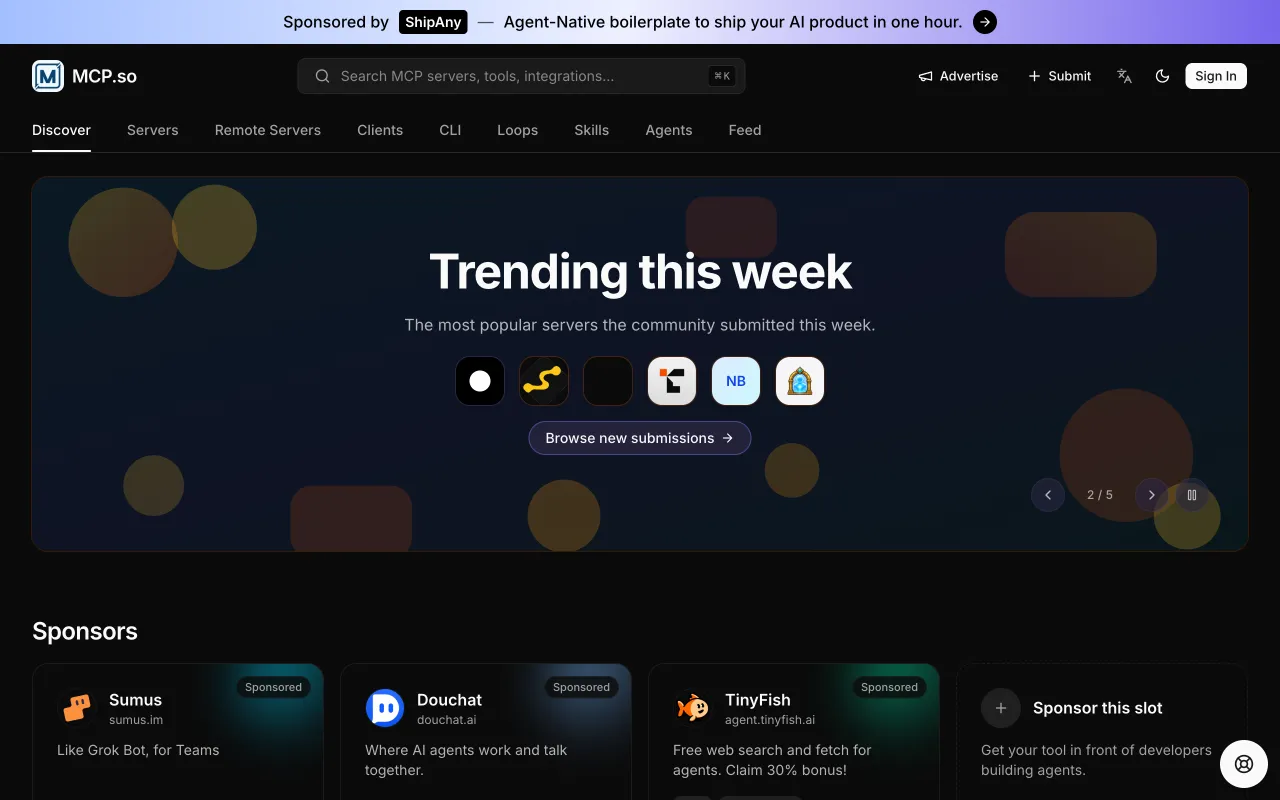
mcp.so's FAQ calls it a community-driven platform that collects and organizes third-party MCP servers. Besides servers it lists remote servers, clients, command-line tools, agent skills and agents. You submit a server through a GitHub issue. The page does not say whether mcp.so hosts servers or charges for listings or use.
Best for
- Finding which MCP servers exist for a tool you already use.
- Seeing what other people are connecting to their agents.
Strengths
- Browse by category and tag, with featured and trending items.
- Anyone can submit a server.
Limits
- It is a directory. You still sign up with each server's owner and hold each key.
- The page gives no billing details, so cost is whatever the listed server charges.
Does not fit an agent that needs one bill for many APIs.
Alternatives to RapidAPI: what changes for an agent
RapidAPI alternatives split into three kinds. A publisher marketplace such as Nokia API Hub or the Apify Store lists APIs from many authors. A single-vendor catalog such as Bright Data's lists its own. A directory such as mcp.so lists servers and leaves billing to the owner. looot is a fourth kind, a catalog from which one token and one balance can call many providers. For the agent, the question is who signs up and who pays, since a person has to do both on a publisher marketplace.
How to choose
Who signs up and pays?
If a person subscribes once and the agent reuses the key, Nokia API Hub or the Apify Store both work. If the agent should pay as it goes from a balance, looot fits. MCP vs API for agents explains what changes when the agent connects over MCP.
Do you need a specific site or a specific job?
For one site with a maintained Actor, start at the Apify Store. For a job such as finding an email or enriching a company across several providers, start with looot. The data and APIs tools post covers the second case.
Do you need to publish an API?
Nokia API Hub is built for that. looot is not a place to sell your own API.
| Your need | Pick | Why |
|---|---|---|
| One balance across data providers | looot | Per call, quoted first |
| Browse and subscribe to many publishers | Nokia API Hub | Catalog with discovery |
| A maintained scraper for one site | Apify Store | Actors with a hosted MCP server |
| A dataset of a popular domain | Bright Data | Dataset Marketplace |
| Find an MCP server to add | mcp.so | Community directory |
How to run this with an agent
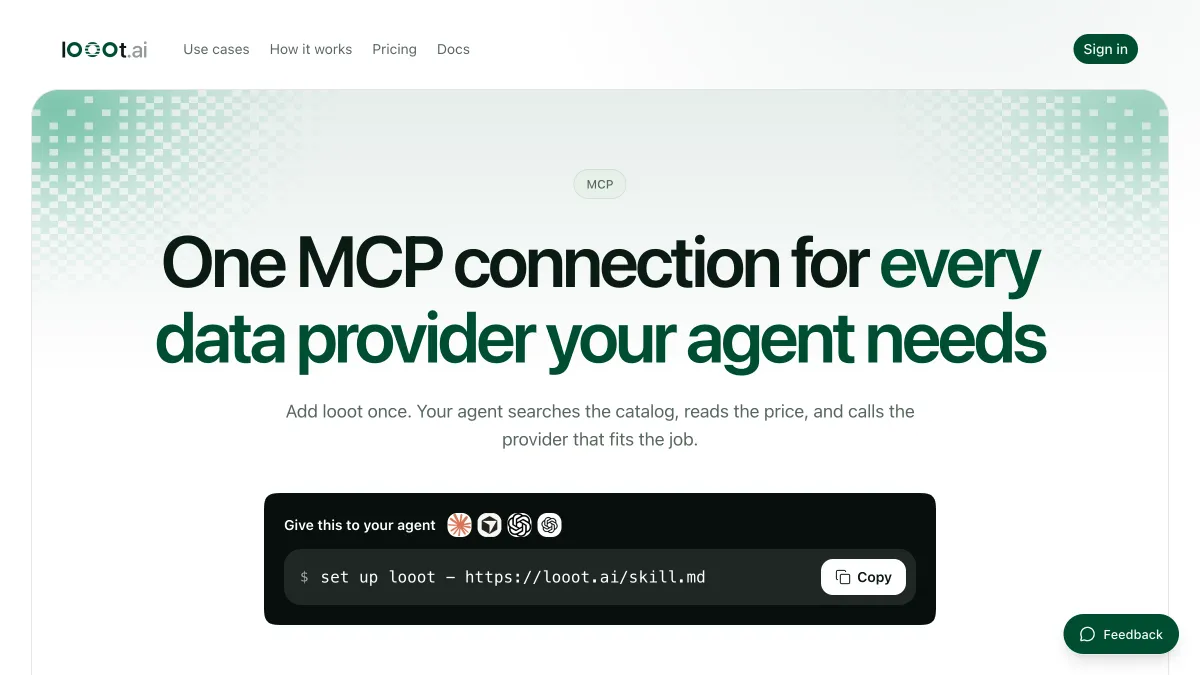
- Connect your agent to looot once with the setup line in the prompt below.
- Describe the API you were looking for, such as "find the company behind a domain".
- Ask the agent to search the catalog and list every operation that matches, with its price and inputs.
- Run the cheapest on one domain and read the result.
- If nothing matches, search a marketplace above for the missing API.
Prompt for your agent
Find an API by describing the job
What this post does not cover
It compares five places by what their public pages say. It does not rank API quality, it does not test a single listing, and it does not cover cloud provider marketplaces, end-user app stores or API management software. Nokia API Hub also has an enterprise side that we did not read. A recurring job needs scheduled runs, which looot does not offer yet, so run it by hand.
Last checked 2026-10-12 against each public page and the public looot catalog at https://api.looot.ai/v1/public-catalog. Author: the looot team.
Questions
Keep reading
MCP gateway: what it does and when an agent needs one
An MCP gateway puts many tools behind one connection, one login and one bill. How it works, when you need one, and what looot's gateway does.
The looot team · · 7 min read
AI agent tools: the data and APIs an agent needs
The AI agent tools that matter most fetch real data. A plain map of the jobs agents call tools for, and how to connect them without a dozen keys.
The looot team · · 7 min read
MCP vs API for agents: when each one fits
MCP and a plain API both let an agent reach outside data. What the agent handles in each, when to pick which, and a prompt to test both on your job.
Walid Boulanouar · · 5 min read
Try it with the agent you already use
Start your workspace, top up, and paste one prompt into your agent.